Lost time and memory gaps
The Minds of Billy MilliganLost time and memory gaps are not merely missing details in Billy Milligan’s account of his past; they disrupt his ability to know what he has done, learned, or experienced. Their consequences range from a bewildering classroom test to years of concealment, and their recurrence after fusion shows that a period of apparent integration has not secured continuous memory.
Definition and Experience
Billy Milligan describes the problem as more than forgetting a particular memory. After the trial, he tells Dr. David Caul that he feels less together with the others and that more pieces are missing. His image of missing pieces gives the experience both a cognitive and an organizational dimension: what is absent is not only information, but also the former sense of connection among the inner personalities.
The gaps vary in scale. Billy Milligan can lose track of what happened minutes or hours earlier, and at other times cannot account for days. Their defining feature is the break between an action and his later knowledge of it. He may remember getting up in the morning, yet have no memory of getting dressed or traveling to school. When the narrative returns to his point of view, the present scene is already under way and its preceding events remain inaccessible to him.
School and Everyday Consequences
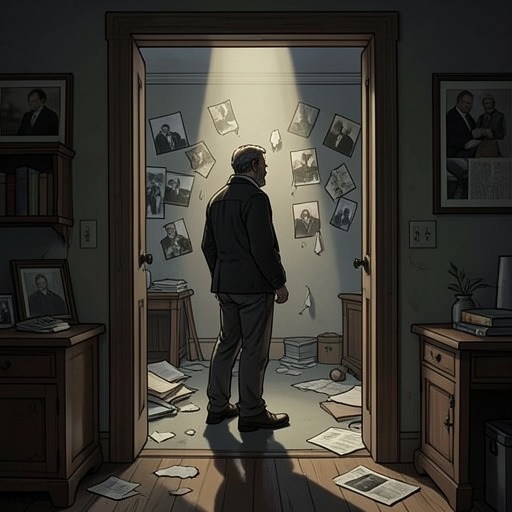
One classroom episode makes this discontinuity concrete. After recess, a teacher asks students to take out their papers. Billy Milligan is startled to find himself in class; he remembers waking at home but not the intervening steps that brought him to school. The ordinary sequence of getting ready, leaving home, and arriving has become an unrecorded interval.
The test in front of him deepens the confusion. He does not know what mathematics paper the class is discussing, but finds a completed paper in his book with answers to all fifty problems. The handwriting resembles his own without appearing to be his, and the work is beyond what he believes he can do. He writes Bill Milligan at the top and prepares an explanation in case the teacher asks about the missing assignment. When asked whether he has finished, he asks whether he passed; the teacher returns the paper with a perfect score. The episode places an inexplicable achievement beside his inability to remember doing the work. The paper is tangible proof that something occurred, but it cannot restore the missing experience or explain it to him.
This pattern extends beyond one test. From fourth through eighth grade, Billy Milligan is repeatedly sent to advisers, the principal, and the school psychologist. Teachers call him truant, a troublemaker, and a liar. Those labels arise in a setting where adults can see his absences, explanations, or unusual behavior but cannot see the missing stretches as he experiences them. The gap between their interpretation and his memory turns an internal discontinuity into a public conflict over conduct and truthfulness.
Concealment and Self-Understanding
Billy Milligan tries to manage that conflict by improvising explanations. He bends the truth or invents a story because he cannot admit that he does not know what happened, sometimes even when the interval is only minutes. In the classroom, his plan to say that he forgot or lost the math assignment illustrates the immediate calculation forced on him: he must answer a question about an event for which he has no memory. Concealment becomes a way to pass through situations that demand a continuous account of his actions.
The text emphasizes that the gaps are noticed by other people. His trances are apparent, and people around him agree that he has said or done things he cannot later recall. Once Billy Milligan understands that other people do not lose time in the same way, he interprets his difference as evidence that he is insane. He keeps the experience secret. The secrecy does not resolve the gaps; it leaves him trying to reconcile his own blank intervals with other people’s certainty about what took place.
Fusion, Separation, and Memory
Later, Billy Milligan connects his memory to the presence of Arthur and Ragen. He says that when they are not with him, his recollection is poor, and that his periods of lost time meant missing much of his own life. Arthur has told him that he kept Billy Milligan asleep for a long time. The account makes the gaps consequential beyond the inability to remember particular acts: Billy Milligan understands them as lost participation in the course of his life.
This explanation also places his post-trial condition in contrast with an earlier fusion. Dr. George Harding had told him that his memory would improve when he fused, and Billy Milligan recalls that it did. After the trial, however, he says that he came apart, and now cannot find Arthur or Ragen in the way he previously could. The earlier improvement and later decline make memory a measure of changing internal organization, but not a simple or permanent cure: fusion is followed by renewed fragmentation and uncertainty.
Dr. David Caul does not claim to know why this change happened. He suggests that they may try to find the missing pieces and put them back together, while also reassuring Billy Milligan that his memory may improve and that he may know more than he expects. The exchange leaves the gaps unresolved. It gives them a place in treatment and in Billy Milligan’s attempt to understand himself, while preserving the distinction between what he remembers, what Arthur has told him, and what remains unavailable to him.